
Table of Contents
Artificial Intelligence (AI), Machine Learning (ML), Deep Learning, 3D rendering, scientific computing, and big data analytics require much more computing power than traditional servers can provide. This is where a GPU server becomes the best solution.
Unlike a standard server that mainly relies on CPUs, a GPU server uses one or more high-performance Graphics Processing Units (GPUs) to perform thousands of calculations simultaneously. This parallel processing capability dramatically improves performance for AI training, data analysis, rendering, simulations, and high-performance computing (HPC).
Whether you’re an AI startup, research organization, enterprise, animation studio, healthcare company, or cloud service provider, investing in the right GPU server can significantly reduce processing time while increasing productivity.
In this complete guide, you’ll learn everything about GPU servers, including how they work, their benefits, applications, features, GPU server price in India, and how to choose the right model for your business.
What is a GPU Server?
A GPU server is a high-performance server equipped with one or multiple Graphics Processing Units (GPUs) in addition to traditional CPUs.
Originally designed for graphics rendering, GPUs have evolved into powerful computing engines capable of executing thousands of tasks simultaneously.
Unlike CPUs that process a limited number of tasks sequentially, GPUs use thousands of processing cores to execute parallel workloads, making them best for AI, Deep Learning, Machine Learning, Data Science, Scientific Computing, and Video Rendering.
Simply put:
- CPU = Better for sequential processing
- GPU = Better for parallel processing
This is why organizations working with AI and large datasets prefer GPU servers.
How Does a GPU Server Work?
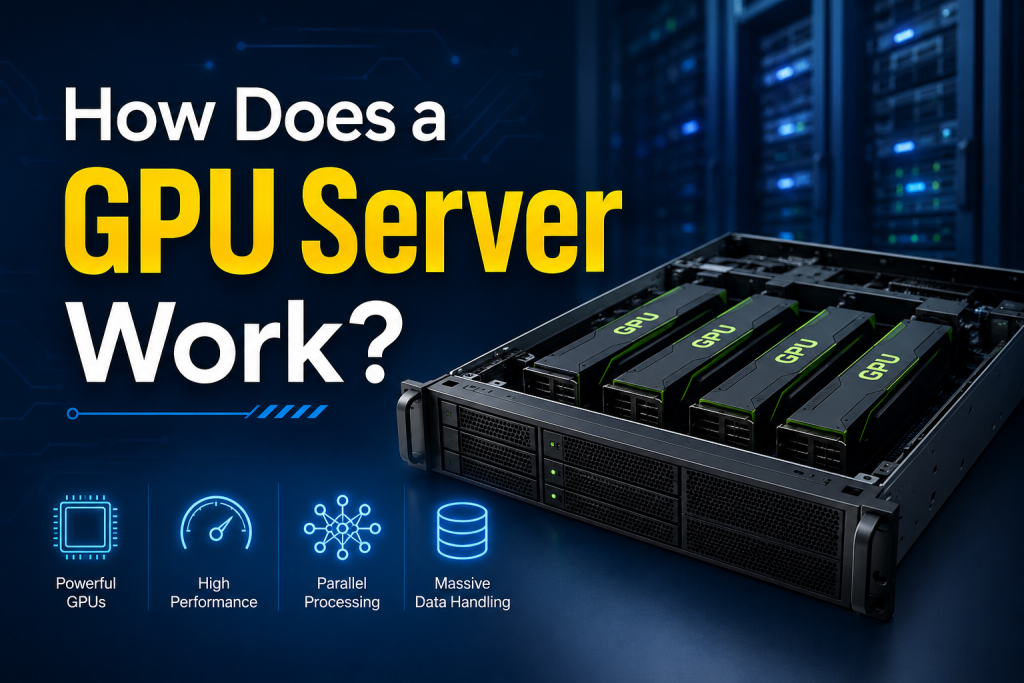
A GPU server combines:
- Multi-core CPUs
- High-performance NVIDIA or AMD GPUs
- Large memory capacity
- High-speed NVMe SSD storage
- High-bandwidth networking
Workflow
- CPU manages instructions.
- GPU performs thousands of calculations simultaneously.
- Data is stored on ultra-fast NVMe storage.
- Results are processed much faster than CPU-only systems.
This architecture dramatically reduces computation time for intensive workloads.
What is the comparison between CPU vs GPU Server ?
Feature | CPU Server | GPU Server |
Processing Style | Sequential | Parallel |
Number of Cores | 8–128 | Thousands |
AI Performance | Moderate | Excellent |
Machine Learning | Slow | Very Fast |
Deep Learning | Limited | Outstanding |
Video Rendering | Average | Extremely Fast |
Scientific Simulation | Moderate | Excellent |
Cost | Lower | Higher |
Power Efficiency | Good | Better for heavy workloads |
Best For | Databases, Websites | AI, HPC, Rendering |
Key Components of a GPU Server?
1. High-End CPUs
The CPU manages operating system tasks while coordinating GPU workloads.
Popular processors include:
- AMD EPYC
- Intel Xeon Scalable
2. NVIDIA GPUs
Most enterprise GPU servers use NVIDIA GPUs because of CUDA support and AI optimization.
Examples include:
- NVIDIA A100
- NVIDIA H100
- NVIDIA L40S
- NVIDIA RTX 6000 Ada
- NVIDIA RTX A6000
3. Large Memory
GPU servers typically include:
- DDR5 ECC RAM
- 128 GB to 2 TB memory
Large memory supports AI model training and virtualization.
4. NVMe SSD Storage
High-speed SSD storage helps eliminate bottlenecks.
Benefits include:
- Faster boot time
- Faster AI dataset loading
- Lower latency
- Higher throughput
5. High-Speed Networking
Enterprise GPU servers often support:
- 25GbE
- 40GbE
- 100GbE
- InfiniBand
These are essential for distributed AI training.
What are the Benefits of a GPU Server?
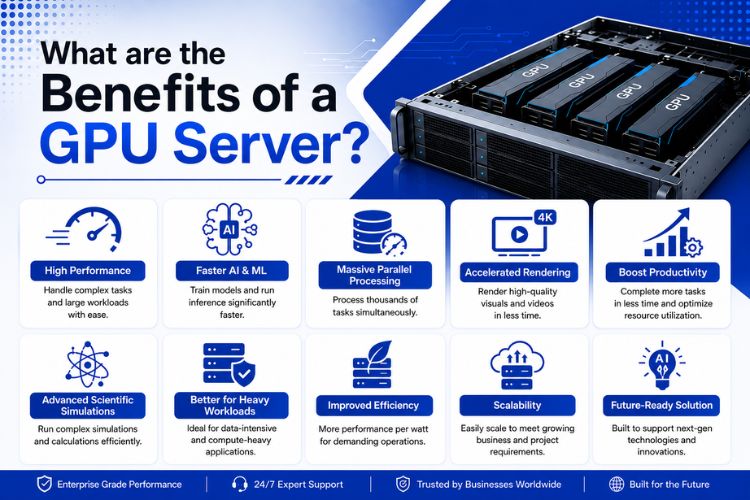
1. Faster AI Model Training
GPU servers can reduce AI training time from several days to just a few hours.
Example:
A machine learning model that takes 48 hours on a CPU may complete in 4 to 6 hours with multiple GPUs.
2. Massive Parallel Computing
Thousands of GPU cores process multiple operations simultaneously.
Best for:
- AI
- Big Data
- Scientific Research
- Image Processing
3. Better Video Rendering
Animation studios and VFX companies use GPU servers for:
- 3D Rendering
- CGI
- Video Editing
- Motion Graphics
Rendering projects can finish significantly faster than CPU-based systems.
4. Excellent for Machine Learning
GPU acceleration speeds up:
- TensorFlow
- PyTorch
- Keras
- CUDA applications
5. Supports Virtual GPU (vGPU)
Businesses can create multiple GPU-powered virtual desktops.
Perfect for:
- CAD Designers
- Engineers
- Architects
- Remote Workstations
6. Higher Productivity
Employees spend less time waiting for rendering or AI training.
This improves operational efficiency.
7. Scalable Infrastructure
Most enterprise GPU servers support:
- Multiple GPUs
- Additional RAM
- More Storage
- High-speed networking
Businesses can scale without replacing the entire infrastructure.
Common Applications of GPU Servers?
GPU servers power some of the world’s most demanding workloads.
Artificial Intelligence
- AI model training
- Large Language Models (LLMs)
- Chatbots
- Recommendation systems
Machine Learning
- Classification
- Prediction
- Data Mining
- Fraud Detection
Deep Learning
Neural networks require enormous computational power.
GPU servers dramatically reduce training time.
Data Analytics
Analyze billions of records quickly.
Useful for:
- Banking
- Healthcare
- Retail
- Telecommunications
Medical Research
Applications include:
- DNA sequencing
- Drug discovery
- MRI analysis
- Medical imaging
Video Editing & Rendering
Perfect for:
- Adobe Premiere Pro
- Blender
- Autodesk Maya
- DaVinci Resolve
Engineering Simulations
Used for:
- CFD
- Finite Element Analysis
- Automotive Design
- Aerospace
Cloud Gaming
GPU servers deliver low-latency gaming experiences for cloud gaming platforms.
What are the Popular GPU Server Models?
ASUS ESC4000A-E10 GPU Server
The ASUS ESC4000A-E10 GPU Server is a high-performance enterprise platform designed for AI, machine learning, virtualization, and HPC.
Key Features
- AMD EPYC Processors
- Multiple NVIDIA GPU support
- PCIe Gen4
- High Memory Capacity
- Enterprise-class reliability
Best for:
- AI Training
- Deep Learning
- Research Labs
- Enterprise Workloads
NVIDIA-3U DGX1 GPU Server
The NVIDIA-3U DGX1 GPU Server is designed for advanced AI research and enterprise-scale deep learning.
Key advantages include:
- Multi-GPU architecture
- Exceptional AI training performance
- High-speed interconnects
- Optimized NVIDIA software ecosystem
It is commonly used by universities, AI research centers, and organizations developing large AI models.
What is the GPU Server Price in India?
The GPU server price in India depends on several factors:
- GPU model
- Number of GPUs
- CPU configuration
- RAM capacity
- Storage
- Networking
- Warranty
- Support services
Typical enterprise GPU server pricing varies significantly based on workload requirements. Entry-level GPU servers are suitable for development and visualization tasks, while multi-GPU systems designed for AI training and HPC represent a larger investment.
Instead of focusing only on upfront pricing, consider the long-term value, including performance, scalability, energy efficiency, and vendor support.
Factors Affecting GPU Server Cost in India
Several factors influence the GPU server cost in India:
- Number of installed GPUs
- GPU generation (A100, H100, RTX series, etc.)
- CPU model
- DDR5 memory capacity
- NVMe storage size
- PCIe generation
- Redundant power supplies
- Network connectivity
- Support and warranty options
Selecting the right configuration ensures you pay for the performance your workloads actually require.
How to Choose the Right GPU Server?
Before purchasing, ask yourself:
What workload will you run?
- AI
- Machine Learning
- Rendering
- CAD
- Scientific Computing
Which GPU is required?
Different GPUs serve different workloads.
Examples:
- RTX Series
- NVIDIA A100
- NVIDIA H100
- L40S
How much memory do you need?
AI models often require:
- 256 GB RAM
- 512 GB RAM
- 1 TB RAM or more
Do you need scalability?
Choose a platform that supports future GPU upgrades.
What storage is required?
Use enterprise NVMe SSDs for:
- AI datasets
- Training models
- Rendering
Does the vendor provide enterprise support?
Look for:
- Hardware warranty
- Installation support
- Technical assistance
- Upgrade options
Why Do Businesses Choose GPU Servers?
Organizations worldwide rely on GPU servers because they offer:
- Faster AI development
- Lower processing time
- Better resource utilization
- Improved research productivity
- Enterprise scalability
- Support for virtualization
- Reliable 24/7 operation
As AI adoption grows across industries, GPU servers are becoming a core part of modern IT infrastructure.
Why Buy a GPU Server from Serverstack?
Serverstack provides enterprise-grade GPU server solutions tailored to businesses of all sizes.
With a focus on performance, reliability, and scalability, Serverstack helps organizations deploy infrastructure for AI, machine learning, rendering, virtualization, and high-performance computing.
Benefits include:
- Enterprise GPU server configurations
- Custom-built solutions
- Competitive pricing
- Fast deployment
- Expert technical guidance
- Reliable after-sales support
- Scalable hardware options
Whether you’re upgrading your infrastructure or starting a new AI project, Serverstack can help you choose the right GPU server for your workload and budget.
Conclusion
A GPU server is no longer a niche solution reserved for research labs. It has become an essential platform for organizations embracing AI, machine learning, data analytics, virtualization, rendering, and scientific computing. By leveraging thousands of GPU cores, these servers deliver exceptional speed, scalability, and efficiency compared to traditional CPU-based systems.
When evaluating GPU server price in India or planning to buy a GPU server, focus on matching the hardware configuration to your workloads rather than choosing solely on cost. A well-configured GPU server can improve productivity, shorten project timelines, and provide a strong return on investment as your business grows.
Ready to accelerate your AI, machine learning, rendering, or high-performance computing projects?
Serverstack offers enterprise-grade GPU servers, including customized solutions featuring the ASUS ESC4000A-E10 GPU Server, the NVIDIA 3U DGX1 GPU Server, and other NVIDIA GPU-powered platforms.
Contact us Serverstack today to discuss your requirements, compare configurations, and find the right GPU server solution for your business with expert guidance and dependable support.
Frequently Asked Questions
1. What is a GPU server used for?
A GPU server is used for AI, machine learning, deep learning, data analytics, 3D rendering, virtualization, scientific simulations, and high-performance computing where parallel processing delivers significantly faster results than CPU-only systems.
2. What is the difference between a CPU server and a GPU server?
A CPU server handles sequential tasks efficiently, while a GPU server processes thousands of operations simultaneously, making it best for AI, rendering, and computationally intensive workloads.
3. What is the GPU server price in India?
The GPU server price in India varies based on the GPU model, CPU, memory, storage, and overall configuration. Entry-level systems are available for smaller workloads, while enterprise AI platforms with multiple GPUs are designed for large-scale deployments.
4. Which industries use GPU servers?
GPU servers are widely used in healthcare, banking, education, automotive, media, research, cloud computing, manufacturing, engineering, and artificial intelligence.
5. Which GPU is best for AI?
Popular enterprise GPUs include NVIDIA H100, NVIDIA A100, NVIDIA L40S, RTX 6000 Ada, and RTX A6000. The best choice depends on your model size, training requirements, and budget.
6. Can GPU servers be used for virtualization?
Yes. GPU servers support virtual GPU (vGPU) technology, enabling multiple users to share GPU resources for virtual desktops, CAD, engineering, and graphics-intensive applications.
7. How many GPUs can a server support?
Depending on the chassis and motherboard, enterprise GPU servers can support anywhere from one to eight or more GPUs, with specialized systems supporting even larger configurations.
8. Is the ASUS ESC4000A-E10 GPU Server suitable for AI?
Yes. The ASUS ESC4000A-E10 GPU Server is built for AI training, machine learning, virtualization, and HPC, offering support for high-performance NVIDIA GPUs and AMD EPYC processors.
9. What makes the NVIDIA-3U DGX1 GPU Server best for deep learning?
The NVIDIA-3U DGX1 GPU Server combines multiple enterprise GPUs, optimized software, and high-speed interconnects, making it a powerful platform for deep learning research and AI model training.